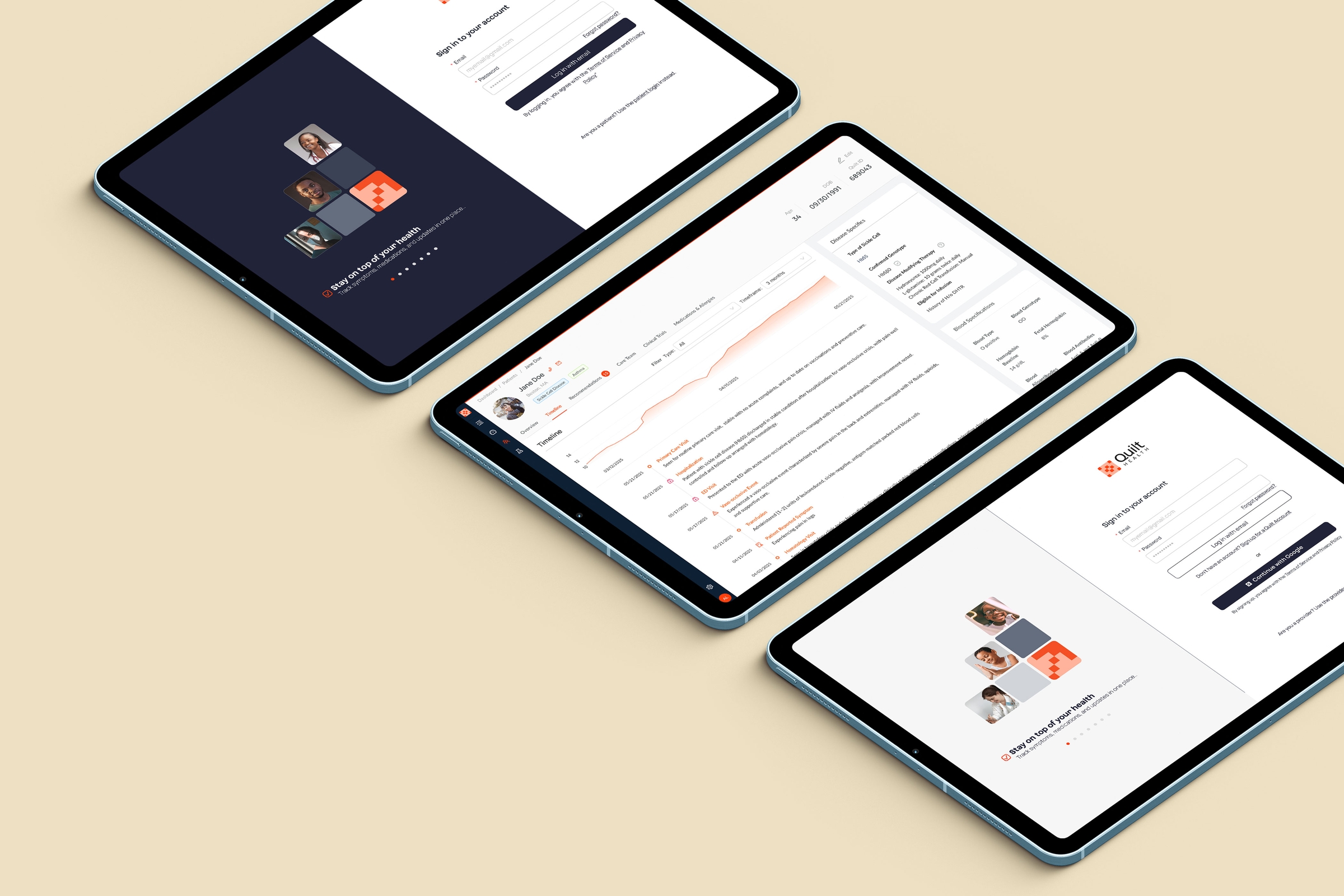
8 months
Quilt Health: Rare Disease Platform
Product design, User research, Product strategy, Usability testing
Role: Lead Product Designer
Team members: Head of Product, Project Manager, 2x Engineers


Quilt is a healthcare platform designed to improve access to care for people living with rare diseases. The platform served three primary user groups: patients, healthcare providers, and pharmaceutical partners.
I joined the team at an early stage when the product existed only as rough concepts and launched MVP versions of both patient and providers app
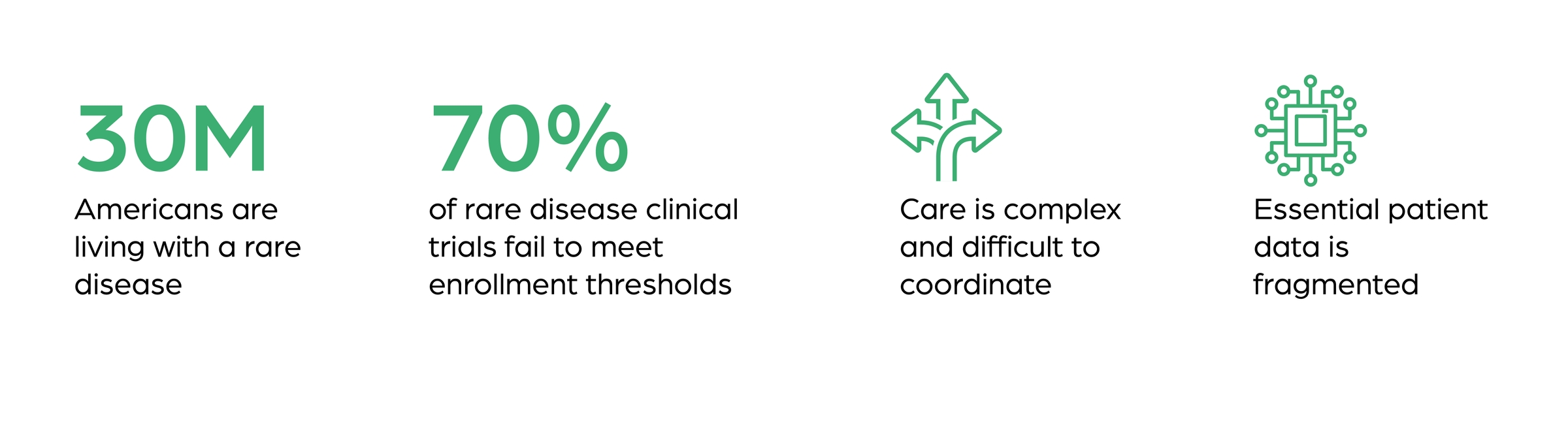
Increasing access to care for people with complex conditions
Quilt's mission is to increase access to care for people with complex conditions through an app that connects them to the providers and clinical research.
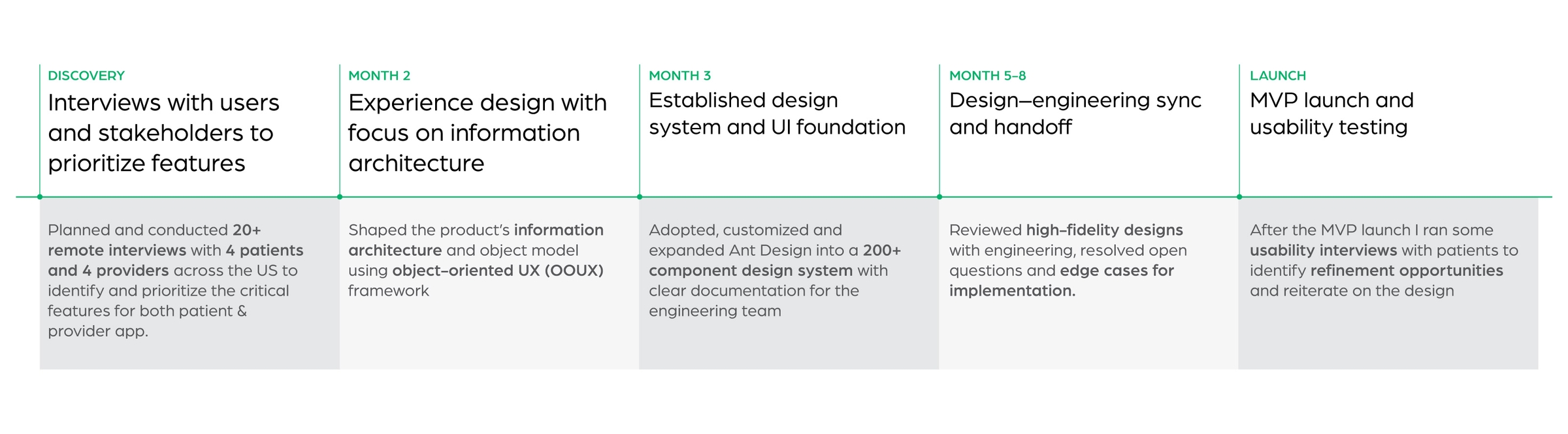
Timeline
I led the end-to-end design of the patient and provider app over 8 months and collaborated closely with 2 engineers and head of product to ship the MVP versions
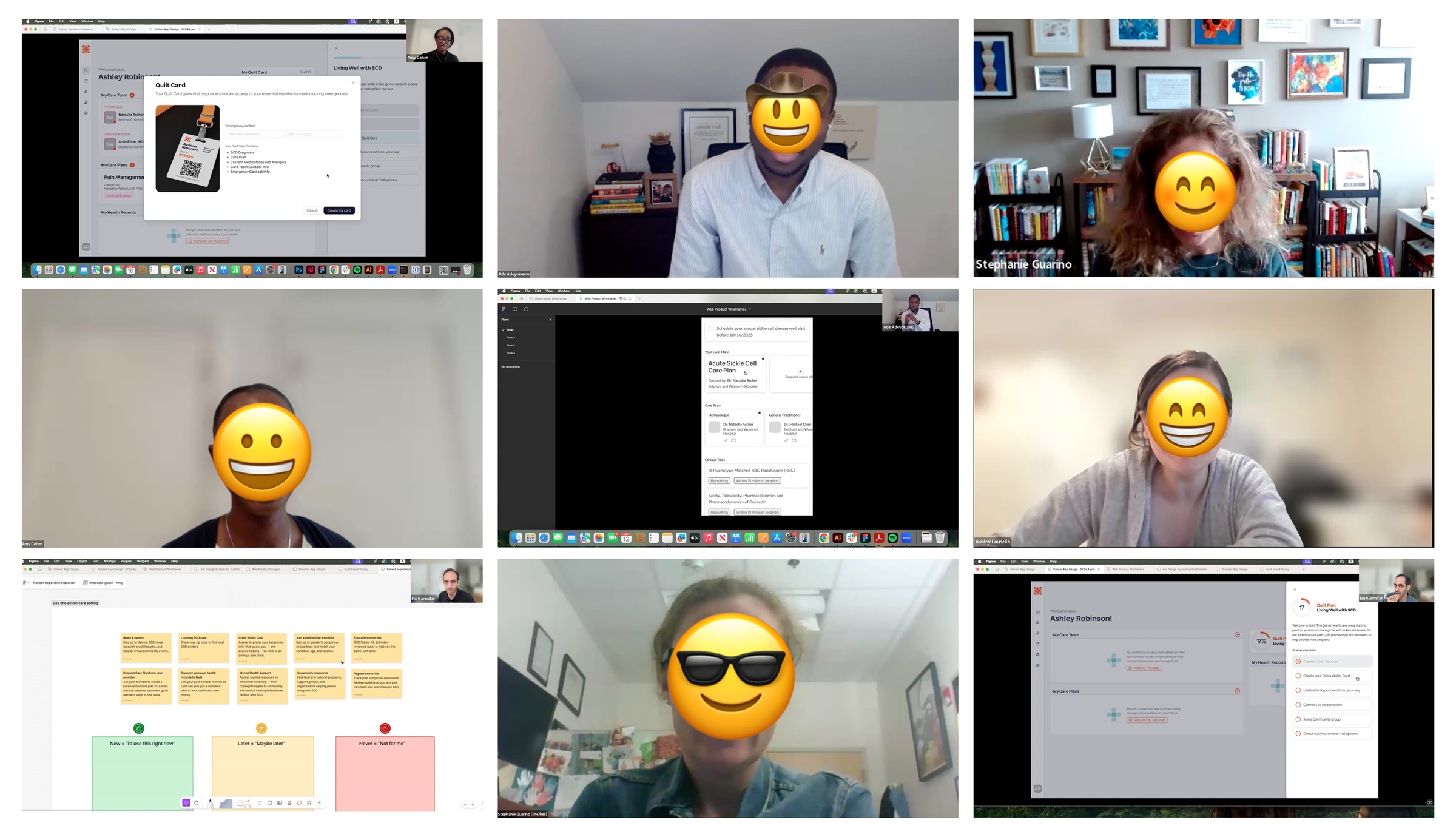
User interview research: Identifying features to design for
We started by focusing on Sickle Cell Disease as a complex condition and I ran more than 20 user interviews with patients and providers to discover their needs and pain points in managing sickle cell disease day to day. Our goal was to uncover and prioritize the most critical user needs and workflows for patients and providers to inform feature definition.
Some of the research methods I used included:
- Generative user interviews (open-ended)
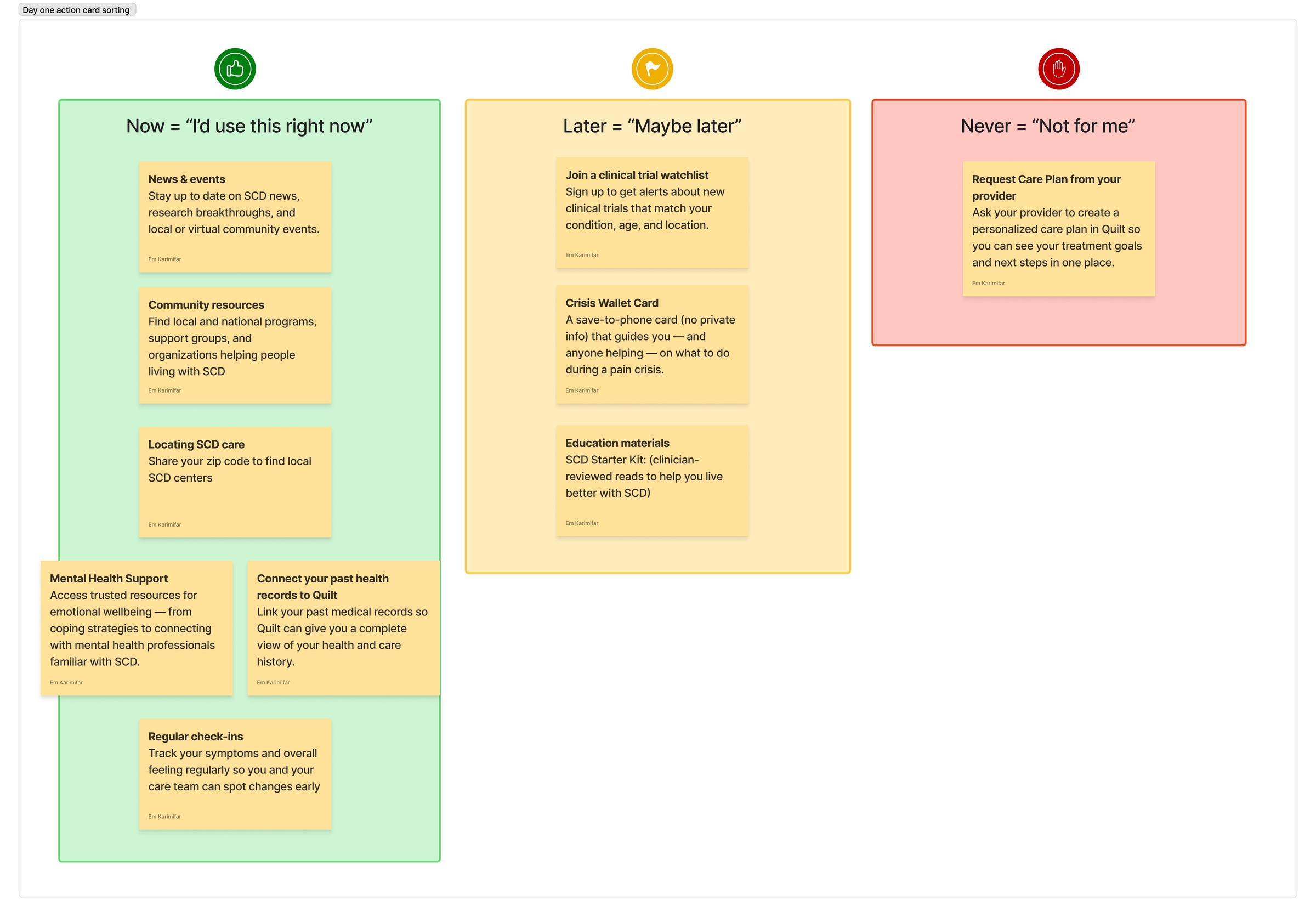
- Workflow observation & card sorting (contextual inquiry)
- Journey mapping (synthesis)
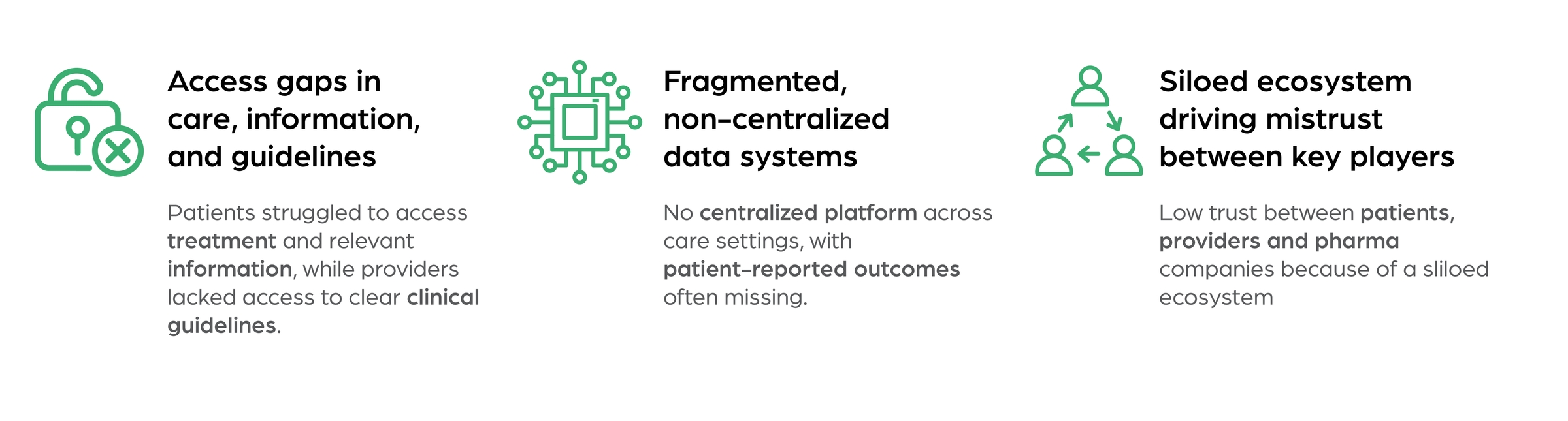
Key findings from user interviews
Information architecture & wireframes
Working within a complex ecosystem of patients, providers, care teams, and pharma stakeholders with distinct roles and permissions, I used Object-Oriented UX (OOUX) framework to define the core entities, relationships, and behaviors. The result was a shared system model that informed feature definition and strengthened alignment across design, product, and engineering.
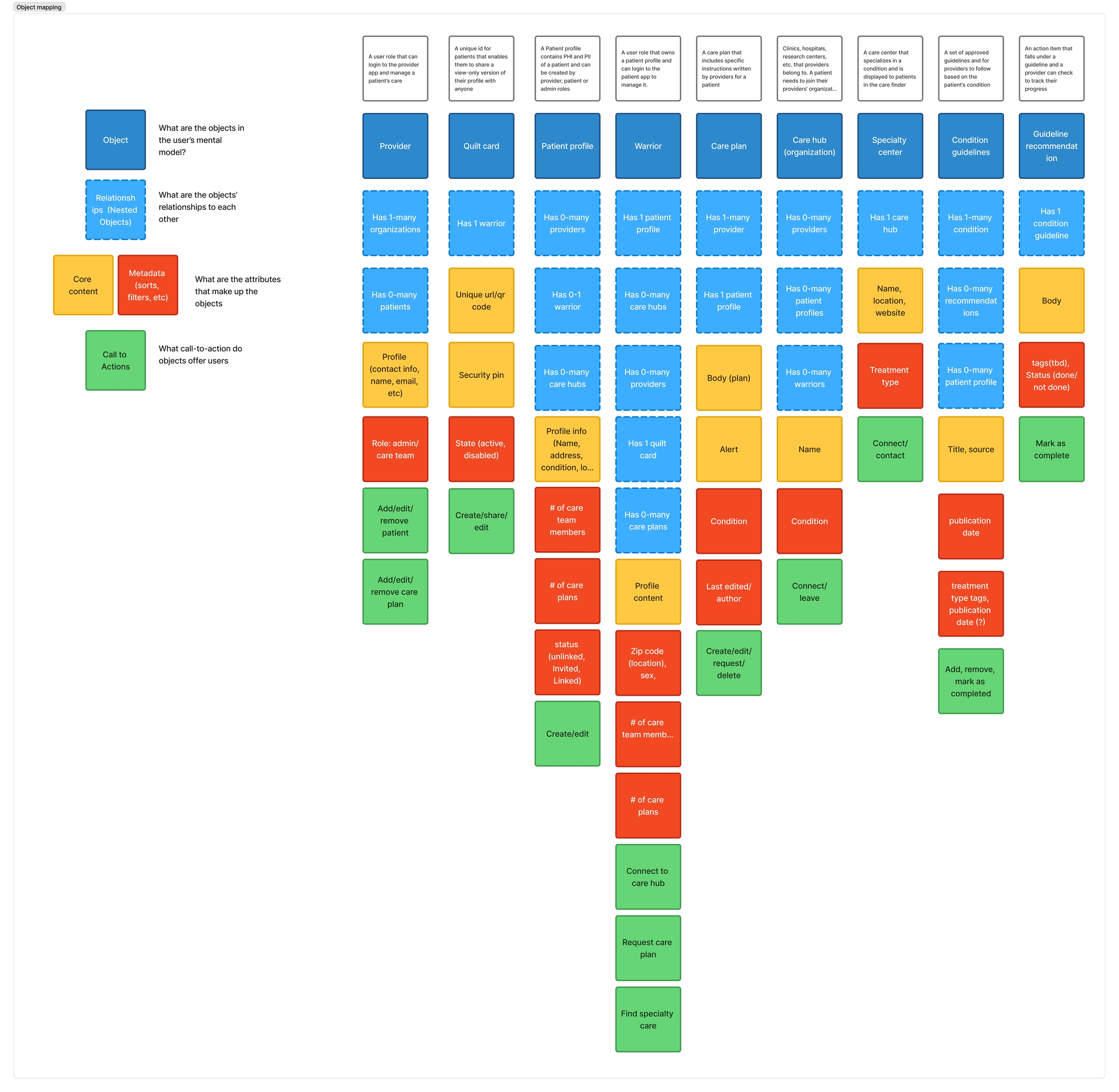
Object mapping artifact built using the OOUX framework, defining the core entities in the Quilt platform alongside their relationships, attributes, and actions. This work happened early in the process to establish a shared mental model between design and engineering before flows and UI were designed on top of it.
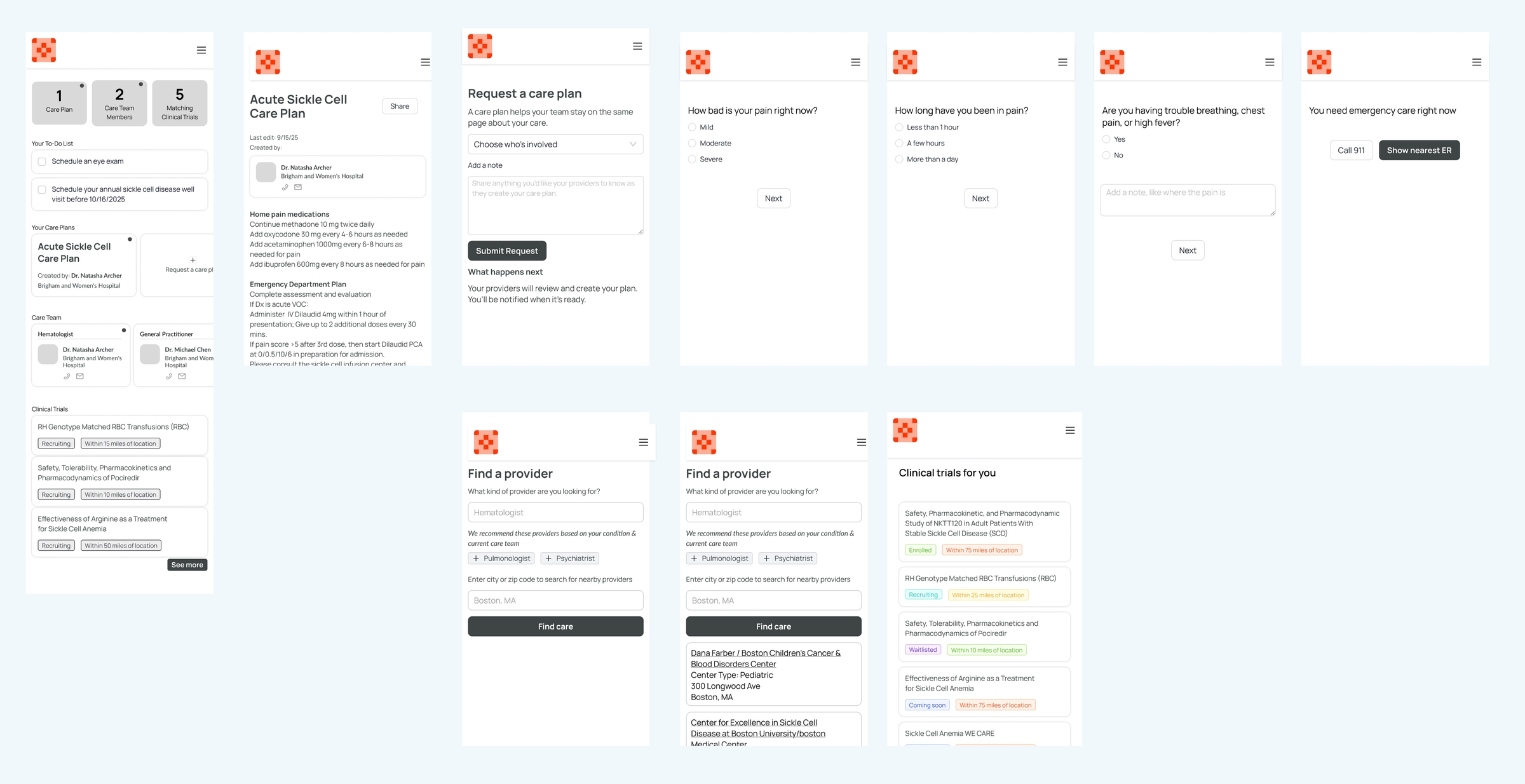
Low-fidelity mobile prototypes used in weekly user interviews to validate proposed features. Keeping them rough and small-screen helped focus feedback on functionality rather than visual design.
Hospital connection flow: helping patients successfully connect to their hospital or care team after registration.
Quilt’s freemium patient app allowed users to sign up independently rather than only through provider invites, which created a key onboarding challenge.
Unlike typical EHR systems where access is typically initiated by the provider, Quilt needed a connection flow that worked for self-serve users with varying levels of information, while still ensuring accurate provider matching and a smooth user experience.
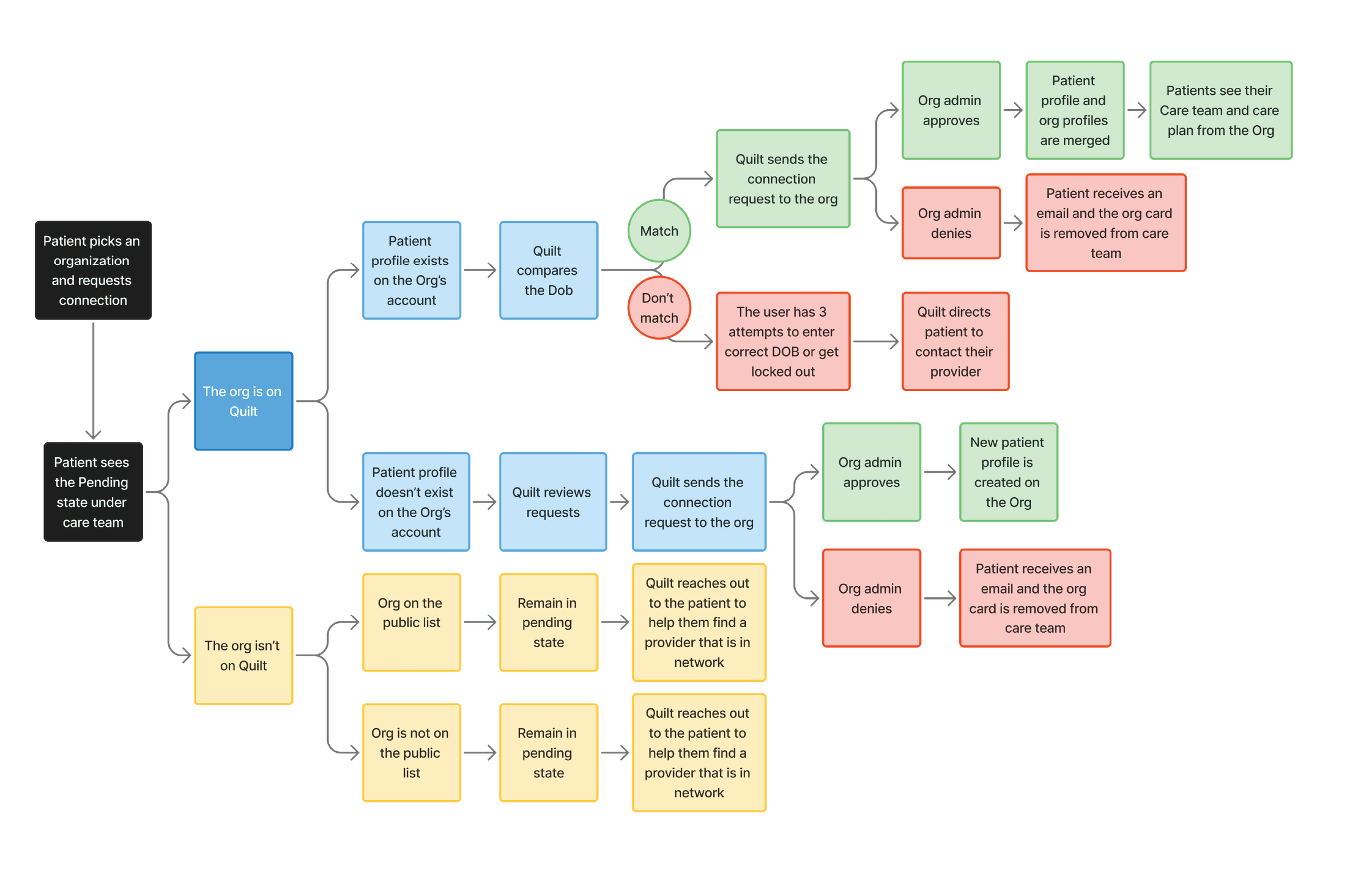
Hospital connection flow diagram that communicated the experience for 3 main scenarios: 1- Merging user profiles, 2- Creating new user profiles in hospital systems 3- Navigator outreach for hospitals not in the system
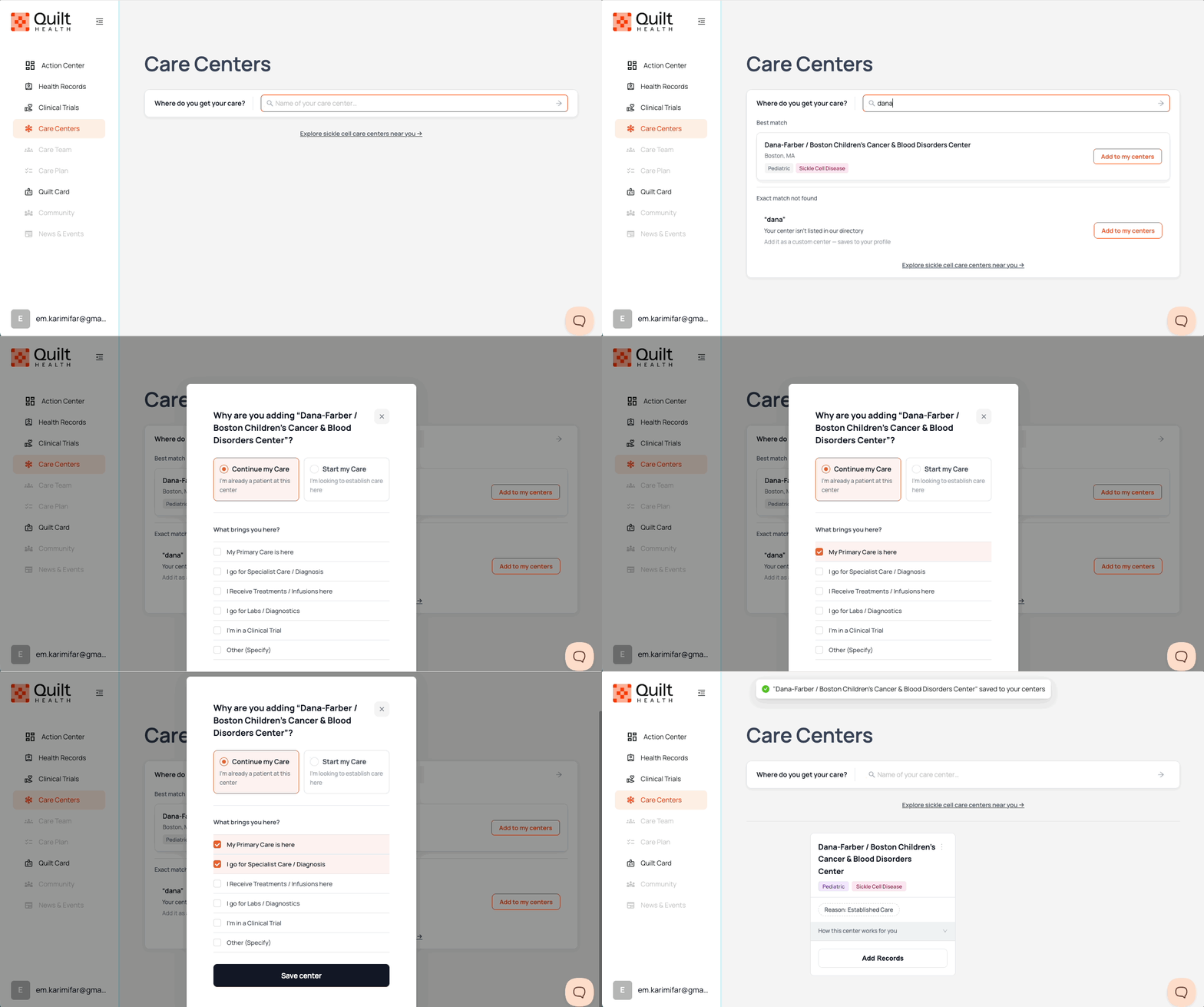
Final UI design for the hospital connectin flow
Design System and UI Foundations
Alongside product flows, I also helped establish the visual and component foundation for the platform.
We used Ant Design as the starting point, then customized it to fit Quilt’s product needs and tone. My role included defining how the system should be adapted, choosing and refining reusable UI patterns, and creating consistency across the patient and provider experiences.
To support implementation and future scale, I also wrote a user guide for the design system, documenting component usage and patterns for the team. This helped create a more consistent handoff process and gave engineering a clearer reference point as the product evolved.
That work was especially important in an early-stage environment where speed mattered, but consistency still needed to be intentional.
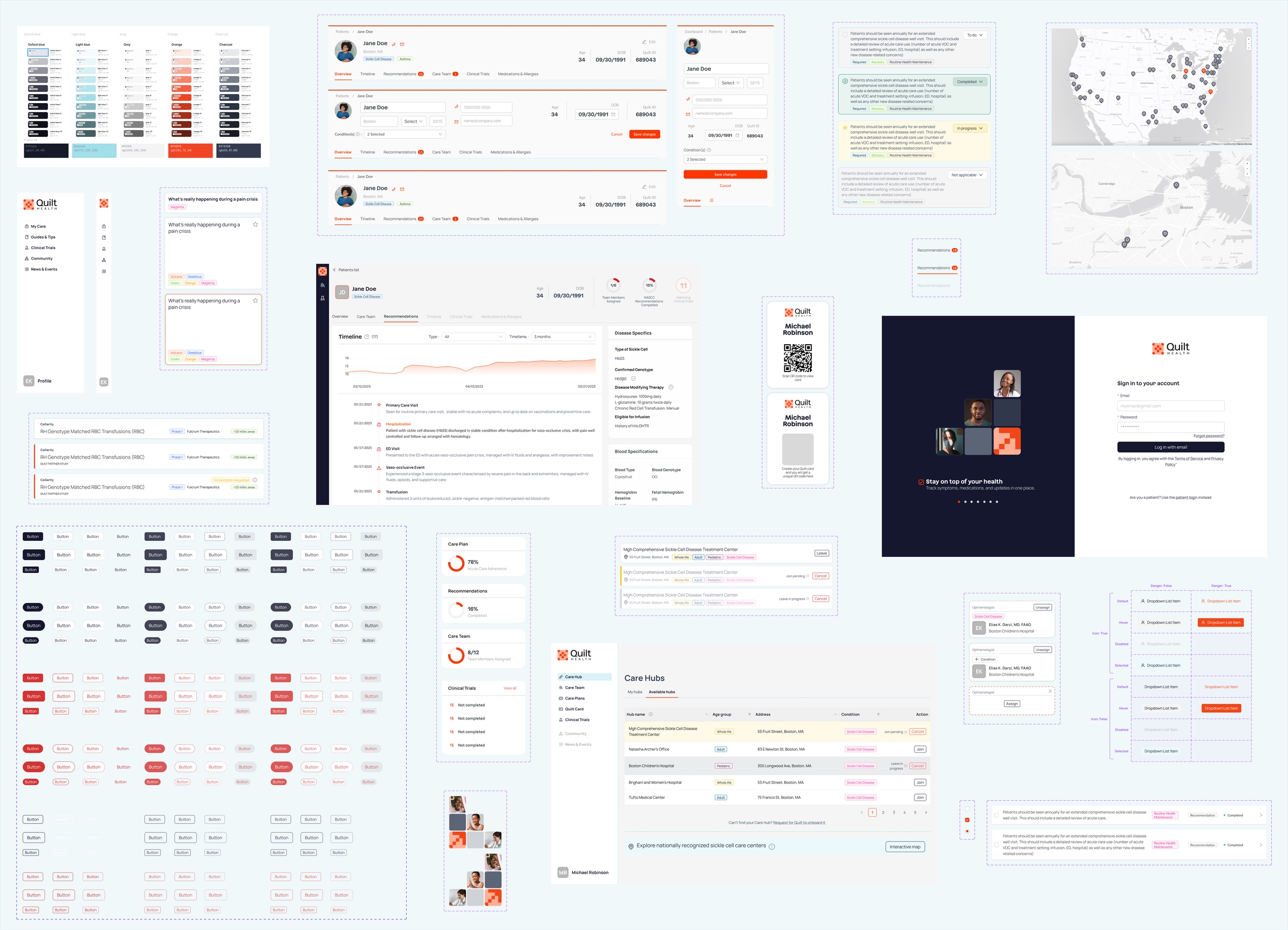
A snapshot of the Quilt design system, showing color tokens, component libraries, button states, and how the system extends into product screens across both the patient and provider applications. Built on top of Ant Design and customized for Quilt's specific needs, the system was documented with usage guidelines to support consistent implementation across the team.
Outcome
Within about 8 months, we shipped MVP versions of both the patient and provider applications. The MVP established the foundation for Quilt’s core care experience, including:
- Care plan
- Care team
- Request care workflow
- Quilt card (for sharing medical history via QR code)
- Clinical trial options
Beyond those shipped features, the work also created underlying product structure that made the platform more coherent: onboarding paths, core objects, interaction patterns, and a documented component foundation for future growth.